Ep. 14 min read
What your pharmacist can help with: Praise Fadzai
Pharmacist Praise Fadzai explains what you can ask about your skin, including everyday product questions and when to see a GP.
Read the episode →
Former Priceline beauty advisor Lily Roulston on how social media changed skincare shopping and what to ask before buying a product.
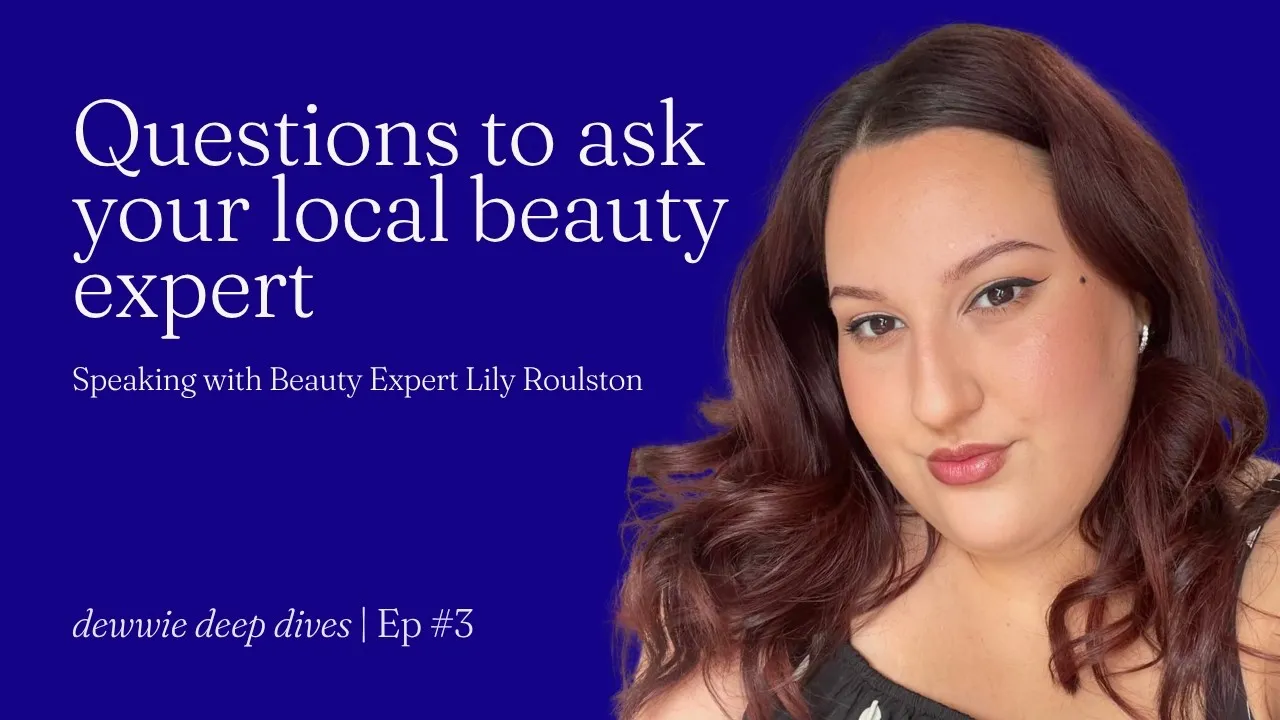
Watch on YouTubeLily Roulston spent seven years as a Priceline beauty advisor. In episode three of dewwie Deep Dives, she talks about the shift from asking for help with a skin concern to arriving with a specific product in mind. We also discuss her own routine and what she wishes more people would ask before buying.
Early in Lily’s retail career, customers often started with a concern and worked through it with an advisor. As skincare became more prominent on social media, she noticed the conversation change: “It went from ‘you’re an expert, help guide me’ to ‘I want to find this product and I need it right now.’”
Knowing what a product did for someone online does not tell you how it will fit your routine. Lily describes how easy it is to focus on one ingredient before asking what you want the product to do. A useful conversation at the counter starts there.
Lily remembers routines growing as customers became more interested in individual ingredients. “Because we became so ingredient focused, our skin barriers have paid the price.” Her observation is a reason to look at how often products are used and what they add to a routine.
Lily describes using an exfoliating cleanser every day because she liked the immediate result. Over time, her skin became dry and flaky. She eventually reconsidered how often she was using it.
She had kept the cleanser because she associated it with an earlier improvement in her skin. When it no longer suited her, she added more hydrating products before questioning the cleanser itself. Looking back, she says her routine needed to change as her skin did.
Start with what you use and what you want help with. Lily explains that an advisor needs to understand the routine before suggesting another product. Preferences matter too, particularly for makeup. “If you work outdoors in the sunshine all day long, what you want in a long-wear foundation is gonna be so different to what I would want.”
Lily describes her training as focused on finding something suitable: “We’re here to help people find solutions. We’re not here to sell them a billion products.” If a product is recommended, ask why it fits what you’ve shared.
“I know the best thing for me, but it doesn’t mean I always do it.” Lily talks about forgetting steps and having days when removing makeup feels like too much. She finds a simpler routine easier to return to, with products kept within reach.
Sunscreen is a recurring point in the conversation. For guidance on when and how to use it with other sun protection, see Cancer Council’s sunscreen information.
Lily discusses how marketing can keep your attention on what you would like to change about your skin. Before buying, it helps to name what you want a product to do and check whether the claim supports that. As she puts it, “One product isn’t this fix at the end of the day.”
Lily returns to a phrase from her training: stay curious. In practice, that means asking what a product does and listening to the reasoning before deciding whether it belongs in your routine.
Pharmacist Praise Fadzai explains what you can ask about your skin, including everyday product questions and when to see a GP.
Dr Yalda Jamali explains who to see about your skin and how to recognise when a concern needs medical care.